
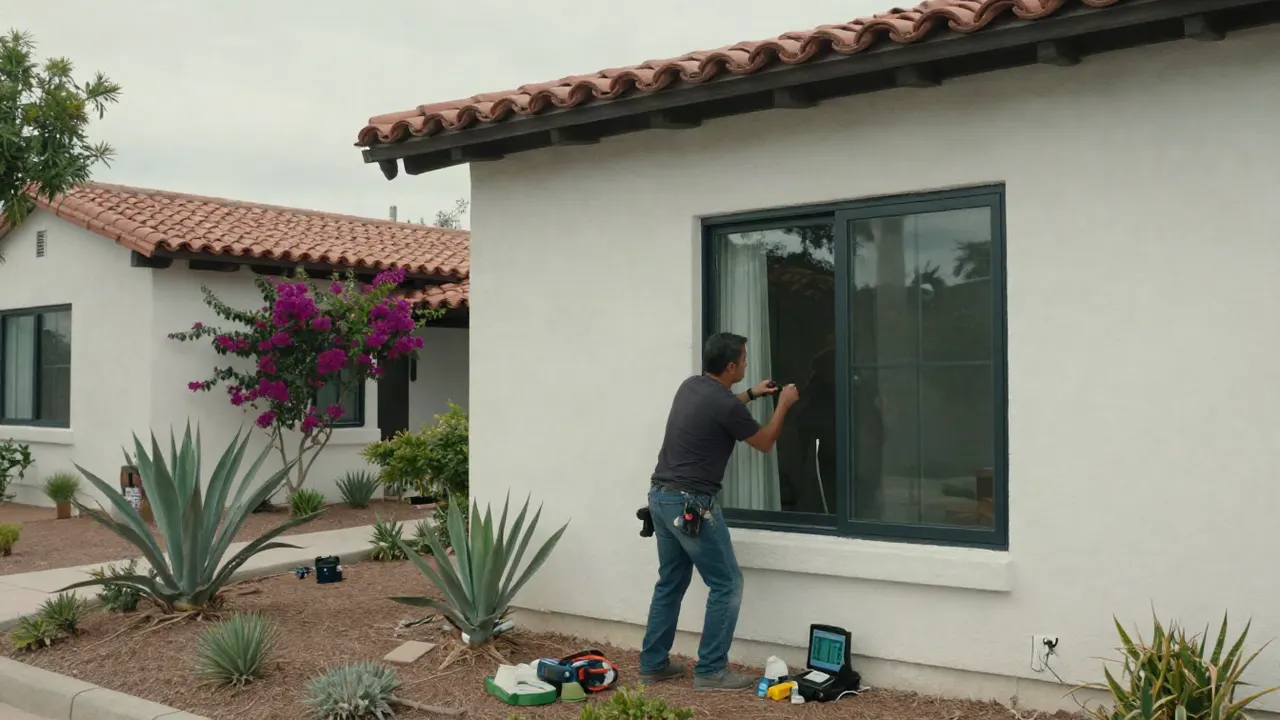
Choosing energy efficient windows for a Southern California home comes down to four decisions: the right U-factor and solar heat gain coefficient for your climate zone, a frame material that survives UV and heat, a glass package matched to each window's orientation, and an installer who air-seals the opening correctly. Get those four right and you cut cooling bills without paying for cold-climate specs you'll never use.
This guide walks through each decision in the order we make them on real Los Angeles jobs - from climate zone to glass to installation - so you can compare bids on equal footing.
Start With Your Climate Zone, Not the Sales Brochure
Los Angeles sits in a warm climate zone where cooling dominates and heating barely registers, which flips the usual window-shopping advice on its head. Most of the county falls into IECC climate zone 8 through 10, and the ENERGY STAR program treats our region as a cooling-first market. That means the specs that matter most here are the ones that block heat coming in - not the ones that trap heat inside.
A window salesperson who mostly works in colder states will push you toward the lowest U-factor on the sheet. In Los Angeles that's often the wrong trade. You want solar control first, insulation second, because our cooling season runs roughly April through October and our heating season is a few cool weeks in January.
Here's the practical breakdown we use when scoping a job:
- Inland valleys and foothills (Woodland Hills, Northridge, Pasadena, Sylmar): hottest summer temps, often 100°F+ for weeks. Solar control is non-negotiable.
- Westside and coastal (Santa Monica, parts of the South Bay): milder, but marine layer and salt air change the frame and hardware conversation.
- San Fernando Valley (Sherman Oaks, Encino, Studio City, Tarzana): long, dry, hot summers with big west-facing afternoon sun loads.
If you're replacing windows across a whole house, we usually recommend a slightly different glass package for west-facing rooms than for north-facing ones. Same house, different answers.
What Do U-Factor and SHGC Actually Mean for Los Angeles Homes?
U-factor measures how fast heat moves through the whole window, and SHGC (solar heat gain coefficient) measures how much of the sun's heat the window lets in - in Los Angeles, SHGC matters more. U-factor runs from about 0.15 (excellent) to 1.20 (single-pane aluminum). SHGC runs from 0 to 1, where lower means less solar heat enters.
For most Los Angeles homes, we target:
- U-factor: 0.30 or lower for the whole window (not just the glass center).
- SHGC: 0.25 or lower on west- and south-facing windows; 0.25-0.40 is fine on north-facing glass.
- Visible transmittance (VT): 0.40 or higher so rooms don't feel dim.
- Air leakage: 0.3 cfm/ft² or less.
Those numbers line up with the ENERGY STAR Most Efficient criteria for the Southern California climate and with Title 24 prescriptive requirements for replacement windows. If a bid doesn't list whole-window U-factor and SHGC on the sticker, ask for it before you sign anything.
One more number worth knowing: a typical single-pane aluminum window in an older LA home has a U-factor around 1.10 and an SHGC near 0.75. Moving to a double-pane Low-E unit at U-0.28 / SHGC-0.23 cuts solar heat gain by roughly two-thirds. That's the difference you actually feel in August.
For a deeper look at how those glass packages are built and installed, our team handles Energy Efficient Window Installation Los Angeles CA with whole-window ratings documented on every order.
Which Window Frame Material Is Best for Los Angeles CA?
Vinyl and fiberglass are the two frame materials that hold up best in Los Angeles, and the right pick depends on sun exposure and how long you plan to stay. Both resist rot and termites, both handle our UV load, and both insulate far better than the aluminum frames common in 1960s-1980s tract homes.
Here's how we compare them on real jobs:
- Vinyl: lowest cost, good thermal performance, fine for most inland and valley homes. Watch for cheap thin-wall extrusions - they warp on west-facing walls after a few hot summers.
- Fiberglass: stronger, more dimensionally stable in heat, holds paint and finish longer. Worth the upcharge on large west- and south-facing windows and on homes near the coast where salt air attacks hardware.
- Aluminum: still common, but unless it has a thermal break it's the worst performer in our climate. We replace a lot of it.
- Wood: beautiful on historic Pasadena and Hancock Park homes, but requires maintenance every few years in our sun.
If you're weighing frame options across a whole house, our Vinyl Energy Efficient Windows Los Angeles CA page covers the specs we install most often in the Valley and inland neighborhoods. For coastal and high-sun homes, fiberglass is usually the better long-term call.
Glass Packages: Low-E, Double Pane, Triple Pane, and When Each Makes Sense
Low-E glass with argon fill in a double-pane unit is the sweet spot for almost every Southern California home, and triple pane is usually money you don't need to spend here. Low-E coatings reflect infrared heat while letting visible light through, and in our climate a solar-control Low-E on the west and south sides does more for your summer bill than an extra pane of glass.
Where each option fits:
- Double-pane Low-E, argon-filled: the default for 90% of LA replacements. U-factor around 0.28-0.30, SHGC around 0.23-0.27.
- Triple pane: worth considering on a single loud street (sound control) or a room with a wall of west glass, but the energy savings over good double pane in zone 8-10 are modest.
- Laminated glass: the right call for homes near freeways or flight paths - it cuts noise and holds together on impact.
- Low-E with a higher SHGC (0.35-0.40): sometimes better on north-facing glass where you want daylight and a little passive warmth in winter.
If you want the technical detail on coatings and which side of the glass they sit on, our Low-E Window Replacement Los Angeles CA page breaks down the options we stock.
Window Style and Orientation: Where the Sun Actually Hits
Window style affects air sealing, and air sealing affects energy performance as much as the glass does - a casement or awning window that compresses against a gasket leaks less air than a slider. That matters in Los Angeles because our biggest energy loss isn't heat escaping in winter; it's hot air and solar gain pushing your AC harder all summer.
What we see on orientation:
- West-facing: the toughest wall in LA. Afternoon sun loads are brutal from May through September. Use the lowest SHGC you can get and consider exterior shade or awnings.
- South-facing: strong sun but easier to shade with an overhang. Low SHGC still pays.
- East-facing: morning sun, moderate load. Standard Low-E double pane is fine.
- North-facing: least solar load. You can relax SHGC and prioritize visible light.
Style-wise, casement and awning windows seal tighter than sliders, and fixed picture windows are the tightest of all. If you have a big view wall, a fixed unit flanked by casements usually outperforms three sliders. Our Energy Efficient Casement Window Installation Los Angeles CA page covers the sealing details.
For sliding doors and slider windows, the hardware and weatherstripping do most of the work - a cheap slider will leak air no matter how good the glass is. We install Energy Efficient Sliding Window Replacement Los Angeles CA with upgraded rollers and dual weather seals for exactly that reason.
What to Watch Out For
The most common mistake we see on Los Angeles window bids is a homeowner comparing total price without comparing the specs behind it - a $9,000 bid and a $14,000 bid are only comparable if the U-factor, SHGC, frame, and installation scope match. Here's what to check before you sign:
- Whole-window ratings, not center-of-glass. A sticker that says "U-0.20" but only rates the glass center is hiding the frame's performance.
- Cheap vinyl on west walls. Thin-wall extrusions warp and the seals fail within a few summers.
- Skip-the-permit bids. Window replacement in LA requires a permit in most cases, and skipping it can complicate a future sale.
- No air-sealing in the scope. If the installer isn't foaming and caulking the rough opening, you're paying for glass and losing the gain to leaks.
- Triple-pane upsells. In our climate, the payback on triple pane over good double pane is usually measured in decades, not years.
- Sticker removal before inspection. The NFRC label is your proof of performance - keep it until the job is signed off.
One more: don't buy on brand alone. Two windows with the same NFRC ratings perform the same on paper; what separates them is the frame quality and the install.
When to Call a Professional
Call a professional when you're replacing more than a single window, when the existing frames are aluminum or original to a pre-1980 home, or when you can feel air moving around a closed window on a still day. Those are the jobs where measuring, flashing, and air-sealing decide whether the new windows actually perform.
We're American Reliable Windows & Doors, and we install Energy Efficient Window Replacement Los Angeles CA across the Valley, Westside, and foothill neighborhoods. Our team measures every opening, matches glass packages to orientation, and pulls the permits. If you're in a hot inland pocket like Woodland Hills energy efficient window replacement, we'll spec a lower SHGC than we would on the coast - same house style, different climate load.
If you're not sure whether your current windows are worth replacing or just resealing, we'll tell you straight. Sometimes a $400 air-sealing job beats a $12,000 window order.
Frequently Asked Questions
How do I choose energy efficient windows for my Los Angeles home?
Start with SHGC under 0.25 on west and south glass, whole-window U-factor at 0.30 or lower, and a vinyl or fiberglass frame. Then match the glass package to each window's orientation. Those three decisions cover most of the performance you'll ever notice.
What are the best energy efficient windows for Southern California?
Double-pane Low-E windows with argon fill, in vinyl or fiberglass frames, rated around U-0.28 and SHGC-0.23. That combination handles our cooling load without the cost of triple pane, which rarely pays back in climate zones 8-10.
Which window frame material is best for Los Angeles CA?
Vinyl is the best value for most inland and Valley homes; fiberglass is worth the upcharge on large west-facing windows and coastal homes. Avoid non-thermal-broken aluminum, which is the worst performer in our heat.
What U-factor should windows have in Los Angeles California?
Aim for a whole-window U-factor of 0.30 or lower. You can go to 0.28-0.30 with good double-pane Low-E and still hit Title 24 prescriptive requirements. Below 0.25 usually means triple pane, which is rarely worth the cost here.
How do I compare energy efficient windows in Los Angeles?
Compare the NFRC sticker on each bid: whole-window U-factor, SHGC, visible transmittance, and air leakage. Then compare frame material, glass package per orientation, and whether air-sealing and permits are included. Price alone tells you nothing.
Get Help With Energy Efficient Window Replacement in Los Angeles
If you want a straight answer on which windows fit your house, your orientation, and your budget, we'll walk your home and spec it room by room. Call American Reliable Windows & Doors at (747) 350-1790 to schedule a measure and get 2026 pricing for your project.