
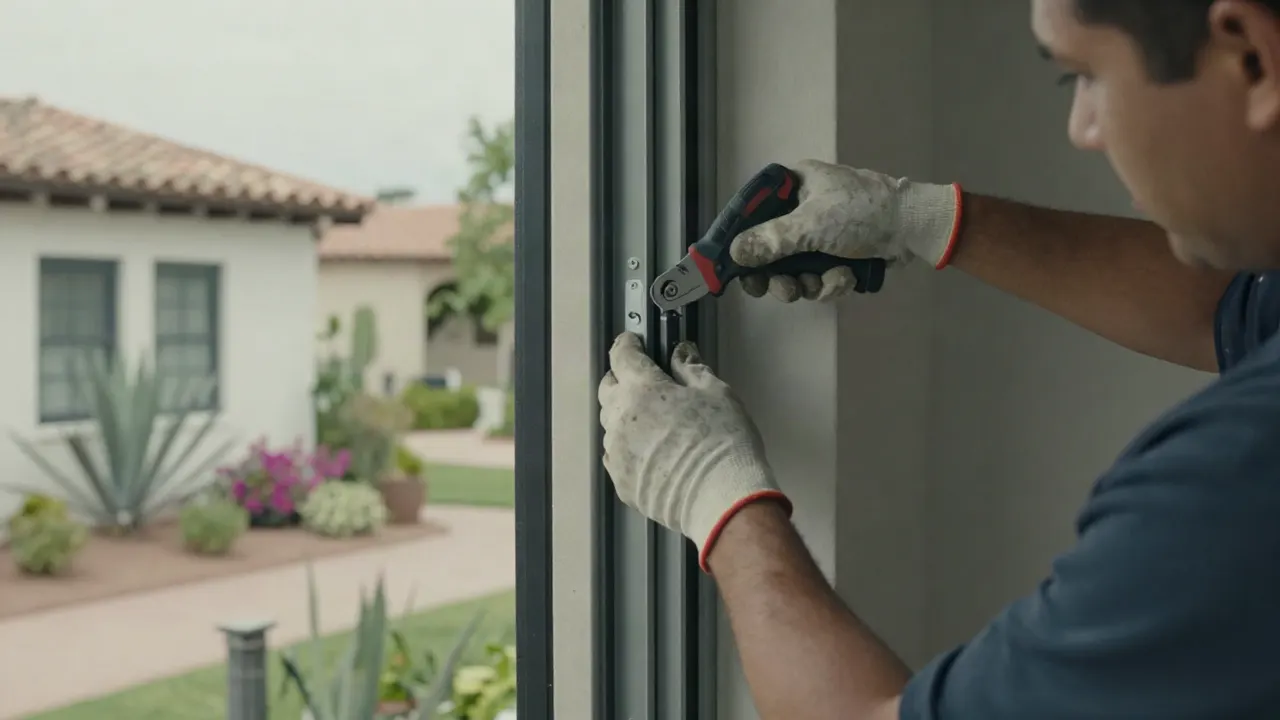
Window frame materials affect home insulation because the frame is the thermal bridge between your conditioned room and the outside air - a conductive aluminum frame can lose 3 to 5 times more heat per square foot than a thermally broken vinyl or fiberglass frame, and that gap shows up on your summer bill. In Los Angeles, where afternoon sun pushes glass-surface temperatures past 140°F and winter nights still drop into the 40s, the frame you choose decides whether your glazing upgrade actually pays off. Below we break down how each material performs, what it costs in 2026, and which frames hold up best to LA's UV load, marine air, and older housing stock.
The Short Answer: Frames Are Half the Window
How window frame materials affect insulation Los Angeles CA homeowners feel every August is simple: the frame conducts heat, and the material determines how fast. A window is a system - glass, spacer, seal, and frame - and the frame occupies 10 to 30 percent of the total window area depending on size and configuration.
That sounds small until you run the numbers. On a standard 3-by-5-foot single-hung window, the frame and sash can account for roughly a quarter of the surface area. If that frame is uninsulated aluminum, its U-factor sits around 1.0 to 1.3 Btu/h·ft²·°F, while a multi-chamber vinyl or fiberglass frame lands near 0.25 to 0.35. The glass may be identical; the whole-window performance is not.
The definition worth memorizing: window frame material insulation is the ability of the frame and sash assembly to resist heat flow, measured by U-factor and expressed in how many BTUs cross each square foot per degree of temperature difference. Lower is better. ENERGY STAR's Version 7.0 criteria for the Southern California climate zone require a whole-window U-factor of 0.32 or lower on most products - and you cannot hit that number with a poorly insulated frame no matter how good the glass is.
We install Energy Efficient Window Replacement Los Angeles CA across the San Fernando Valley, the Westside, and the foothill neighborhoods, and the frame conversation is the one that changes homeowners' minds most often.
How Window Frame Materials Affect Insulation in Los Angeles CA
Window frame material insulation in Los Angeles works through three mechanisms: conduction through the frame itself, air infiltration at the seams, and radiant heat absorbed by the frame surface and re-radiated inward. Each material handles those three differently.
Conduction is the big one. Aluminum is one of the most thermally conductive common building metals, which is why cheap aluminum sliders from the 1970s and 1980s feel cold in January and hot in July. Vinyl and fiberglass are poor conductors by nature, and both are manufactured with hollow chambers that trap still air - a natural insulator.
Air infiltration is the second mechanism, and it is where installation quality meets material stiffness. A frame that flexes under wind load or expands and contracts excessively will open hairline gaps at the sill and jambs. Fiberglass moves very little with temperature; vinyl moves more; aluminum moves most.
Radiant absorption is the sleeper issue in Southern California. A dark bronze aluminum frame in direct afternoon sun can reach 160°F on the surface. That heat radiates into the room long after the sun moves off. Light-colored vinyl and fiberglass frames stay 30 to 50 degrees cooler on the surface under the same exposure, which is one reason we steer west- and south-facing rooms toward lighter frame colors.
Window Frame Materials Compared for Los Angeles, California
Window frame materials compared for Los Angeles, California come down to five realistic choices for a residential replacement project. Here is how each one performs, what it costs, and where it fits.
Vinyl (PVC) Frames
Vinyl is the most common replacement frame in LA County for good reason: it is the cheapest way to get a thermally broken, multi-chamber frame that meets ENERGY STAR. A standard vinyl frame delivers a U-factor around 0.30 to 0.35 with double-pane Low-E glass. Typical 2026 pricing for a full vinyl replacement window in Los Angeles runs $550 to $950 installed, depending on size and glass package.
The weakness is heat. Standard vinyl can soften and warp above about 165°F, and dark-colored vinyl in direct sun on a west-facing wall gets close to that. We specify heat-stabilized vinyl or a lighter color for those exposures. Our Vinyl Energy Efficient Windows Los Angeles CA page covers the chamber counts and color options we stock.
Fiberglass Frames
Fiberglass is the strongest frame material per pound and the most dimensionally stable across temperature swings. It expands and contracts at roughly the same rate as the glass it holds, which keeps seals tight for decades. U-factors land in the same 0.28 to 0.34 range as good vinyl, but fiberglass holds that performance longer because it does not warp or chalk.
Cost is the trade-off: expect $750 to $1,300 per window installed in 2026, roughly 25 to 40 percent more than comparable vinyl. For west-facing walls, coastal properties, and homes where the windows will stay in place 25-plus years, the premium pays back. See our Fiberglass Energy Efficient Windows Los Angeles CA options for the profiles we install.
Wood Frames
Wood is the best natural insulator of the group - roughly 1,000 times less conductive than aluminum - and it is the right choice for historic and Spanish Colonial homes where the look matters. A wood frame with a clad exterior (aluminum or vinyl over the wood) gives you the interior warmth and the exterior durability.
Raw wood is a poor fit for most of LA. It needs repainting every 5 to 7 years, it swells and shrinks with our dry summers and occasional winter rain, and termites are a real concern in older neighborhoods. Clad wood runs $900 to $1,600 per window installed in 2026. If you own a Craftsman in Pasadena or a 1920s bungalow in Santa Monica energy efficient window replacement territory, clad wood is often the only option that preserves the character.
Aluminum Frames
Aluminum is strong, thin, and cheap to manufacture - and it is the worst performer on insulation unless it is thermally broken. A thermally broken aluminum frame inserts a non-conductive barrier between the interior and exterior aluminum, which brings U-factors down to the 0.35 to 0.45 range. Non-thermally-broken aluminum sits at 0.60 to 0.80 and should not be used on a conditioned space in Los Angeles.
Aluminum is still the right answer for large sliding glass doors and floor-to-ceiling modern glazing where the slim sightlines matter. Expect $700 to $1,200 per opening installed in 2026 for thermally broken aluminum.
Composite and Wood-Composite Frames
Composite frames blend wood fiber with polymer resins to get wood's insulation value and stability closer to fiberglass. They resist moisture better than raw wood and hold paint well. U-factors sit around 0.30 to 0.36. Pricing lands between vinyl and fiberglass, roughly $700 to $1,100 per window installed in 2026. Availability in LA is narrower than vinyl or fiberglass, so lead times can run 6 to 10 weeks instead of 3 to 5.
Which Window Frame Material Is Most Energy Efficient in Los Angeles?
Fiberglass is the most energy efficient window frame material in Los Angeles when you measure performance over the life of the window, because it combines a low U-factor with the dimensional stability to keep that U-factor for 20-plus years. Vinyl is a close second on day one and the better value if budget is the deciding factor.
Here is the practical ranking for a typical LA home, from best whole-window performance to worst:
- Fiberglass - U-factor 0.28 to 0.34, minimal expansion, best long-term seal integrity.
- Vinyl (multi-chamber, heat-stabilized) - U-factor 0.30 to 0.35, lowest cost per point of performance.
- Composite - U-factor 0.30 to 0.36, good moisture resistance, limited local supply.
- Clad wood - U-factor 0.32 to 0.40, best aesthetics, highest maintenance.
- Thermally broken aluminum - U-factor 0.35 to 0.45, chosen for sightlines, not efficiency.
- Non-thermally-broken aluminum - U-factor 0.60 to 0.80, avoid on conditioned space.
One caveat that matters more than the ranking: the frame only delivers its rated performance if the installation is airtight. A top-tier fiberglass frame set into a rough opening with gaps at the sill performs worse than a mid-grade vinyl window installed correctly. That is why we treat Energy Efficient Window Installation Los Angeles CA as a framing and flashing job first, a product job second.
The Los Angeles Climate Factor: Heat Gain, UV, and Salt Air
Los Angeles puts frame materials through a specific combination of stress that most national window guides ignore: intense UV, high summer surface temperatures, dry air, and - within a few miles of the coast - salt-laden marine air.
UV degrades vinyl over time. Cheaper vinyl chalks and yellows after 8 to 12 years of direct sun; heat-stabilized vinyl with a UV-resistant cap layer holds color and impact strength much longer. Fiberglass is essentially UV-stable and does not chalk. Wood, if unclad, needs repainting every 5 to 7 years to keep water out.
Salt air attacks metal. Aluminum frames within roughly 3 miles of the ocean develop pitting and corrosion on the anodized finish unless they are properly coated; powder-coated or PVDF finishes hold up far better. Vinyl and fiberglass are unaffected by salt.
Temperature swings between a 105°F afternoon in Woodland Hills and a 45°F night in January are enough to work loose a frame that expands too much. Fiberglass moves about 1/3 as much as vinyl per degree of temperature change, which is why we recommend it for west- and south-facing walls in the hotter Valley neighborhoods. If you are weighing options in the area, our Woodland Hills energy efficient window replacement work leans heavily on fiberglass and heat-stabilized vinyl for exactly this reason.
Common Mistakes We See on Los Angeles Window Jobs
The most expensive frame mistakes we correct on Los Angeles homes are predictable, and most of them happen before the window is ever ordered.
- Buying on glass specs alone. A homeowner compares two quotes, sees the same Low-E double-pane glass, and picks the cheaper one - without noticing one quote uses non-thermally-broken aluminum. The glass is identical; the whole-window U-factor is 40 percent worse.
- Ignoring frame color on west-facing walls. Dark bronze vinyl on a west wall in the Valley can hit surface temperatures that shorten the frame's life. Lighter colors or fiberglass solve it.
- Skipping the air-seal detail. Frames are only as good as the foam, flashing, and caulk behind them. We see 2- to 3-year-old windows leaking air at the sill because the rough opening was never sealed.
- Mismatching frame and glass warranties. Some vinyl frames carry a 10-year warranty while the glass carries 20. Ask what happens at year 11.
- Choosing wood without a cladding plan. Raw wood on an LA exterior needs a repaint cycle most homeowners do not want to own.
If you want a frame that holds its rated performance for the life of the window, our High Performance Window Installation Los Angeles CA service pairs the right frame with the right glass and a fully sealed rough opening.
When to Call a Professional
Call a professional when you can feel air moving at the frame, when condensation forms on the inside of the frame (not the glass) in the morning, or when a frame is warped enough that the sash no longer latches. Those are frame-level failures, and no amount of caulk fixes them.
Also call us when you are comparing quotes and cannot tell why one is $4,000 cheaper than another. We will walk you through the frame, glass, and installation differences line by line so you are comparing the same thing. American Reliable Windows & Doors handles frame selection, glass specification, and installation as one job, which is the only way the rated numbers actually show up on your bill.
Frequently Asked Questions
How do window frame materials affect insulation in Los Angeles?
Frames conduct heat 3 to 5 times faster in aluminum than in vinyl or fiberglass, and they occupy 10 to 30 percent of the window area. In LA's heat, that difference changes whole-window U-factor by 0.2 to 0.4, which translates to a measurable cooling-load reduction.
Which window frame material is best for Los Angeles CA?
Fiberglass is the best overall for LA's UV and heat load, with heat-stabilized vinyl as the best value. Clad wood is the right call for historic homes. Avoid non-thermally-broken aluminum on any conditioned space.
Do window frames really affect energy efficiency in Los Angeles California?
Yes. A whole-window U-factor of 0.32 versus 0.55 on the same glass package can shift a typical LA home's cooling load by 8 to 15 percent in summer. The frame is the difference in most of those comparisons.
What is the most energy efficient window frame material in Los Angeles?
Fiberglass, at a U-factor of 0.28 to 0.34 with double-pane Low-E glass, and it holds that rating longer than vinyl because it barely expands with temperature. Vinyl is a close second at 0.30 to 0.35.
Are vinyl or fiberglass frames better for Los Angeles homes?
Vinyl wins on price - roughly $550 to $950 per window installed in 2026 versus $750 to $1,300 for fiberglass. Fiberglass wins on longevity and heat stability, especially on west- and south-facing walls in the Valley.
Get Help with Energy Efficient Window Replacement in Los Angeles
If your frames are the weak link in an otherwise good window, we can tell you in one visit whether a frame upgrade, a full replacement, or a reseal is the right spend. Call American Reliable Windows & Doors at (747) 350-1790 and we will walk your windows with you and quote the frame and glass together.